Walt Brennan, host of Fault Line LedgerFault Line Ledger

Case Files · Volume 1

The documentary gives you the drama. This gives you the cause.

$63.4 billion in assets, gone in seven weeks. The whole book is $17.

Research dossiers on 20 company collapses, from Enron to WeWork, each with the timeline, the key numbers, the turning point and the sources. 58 pages you can reread and check.

$17Buy the 58-page book

Instant PDF download. Secure Stripe checkout. All sales are final.

  • 20 cases
  • 3 parts
  • 6 tools
  • 54 primary sources
Cover of Case Files, Volume 1: a green engraving of the Colosseum with Walt Brennan's portrait in a gold medallion
Enron 2001WorldCom 2002Theranos 2018FTX 2022Wirecard 2020Toys "R" Us 2017Sears 2018Lehman Brothers 2008Bear Stearns 2008Washington Mutual 2008Silicon Valley Bank 2023Bed Bath & Beyond 2023Montgomery Ward 2000Circuit City 2009Borders 2011Kodak 2012Blockbuster 2010BlackBerry 2016WeWork 2023Pets.com 2000 Enron 2001WorldCom 2002Theranos 2018FTX 2022Wirecard 2020Toys "R" Us 2017Sears 2018Lehman Brothers 2008Bear Stearns 2008Washington Mutual 2008Silicon Valley Bank 2023Bed Bath & Beyond 2023Montgomery Ward 2000Circuit City 2009Borders 2011Kodak 2012Blockbuster 2010BlackBerry 2016WeWork 2023Pets.com 2000

A letter from the desk

You finished the documentary. You still don't know why it died.

You know the feeling. Forty minutes of footage, a dramatic soundtrack, a founder in a courtroom sketch, and the credits roll before anyone explains what actually broke. The comments under these videos say it better than I can:

"The mark-to-market explanation was the clearest part for me."A viewer, on the one part of an Enron video that explained the numbers
"How many other Enrons are there now?"A viewer, asking the question nobody answers

Here's what I've learned from reading what dead companies leave behind. They rarely die from one scandal. The numbers turn first, usually the profit on each sale or the debt, and everyone ignores them until the story breaks.

So I put twenty collapses in one book, laid out the same way every time: the dates, the four numbers that matter, the day it became impossible to ignore, the one mechanic you need, and the number in the filings that turned first. Then one check you can run today on any company.

Walt Brennan
Host of Fault Line Ledger

A free lesson from the book

How a bank full of government bonds went broke in a day

Silicon Valley Bank held US Treasury and agency bonds, about the safest things money can buy. It failed on March 10, 2023. Here's the same bank seen two ways.

Before: the headline

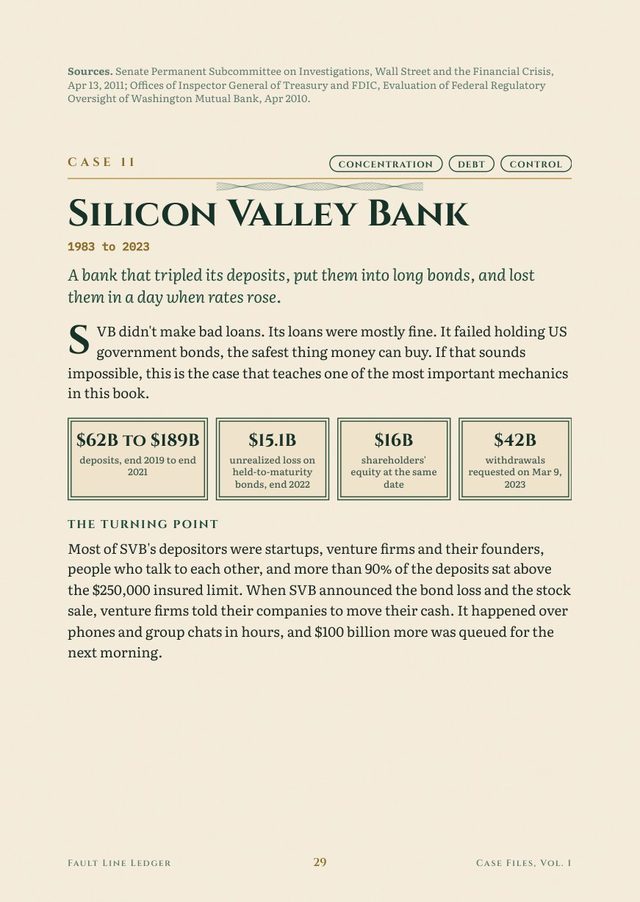
Deposits tripled, from about $62 billion at the end of 2019 to about $189 billion at the end of 2021. Loans mostly fine. A big pile of government bonds, labeled "held to maturity". It looks rich and careful.

After: the drawer

The footnote in the 2022 annual report:

Shareholders' equity, the cushion$16.0B
Unrealized loss on held-to-maturity bonds$15.1B

Valued at market prices, the cushion was nearly gone months before the run.

Why the headline missed it: when rates rise, old low-rate bonds fall in price. Labeling them "held to maturity" lets a bank keep them at cost and push the loss into a footnote, on the promise it'll never have to sell. The promise only holds while depositors stay. More than 90% of SVB's deposits sat above the $250,000 insured limit, and on March 9 customers asked for $42 billion back.

Run it yourself on any bank

  1. Open its latest 10-K on the SEC's free EDGAR site.
  2. Find the note on held-to-maturity securities and write down the unrealized loss.
  3. Find total shareholders' equity on the balance sheet.
  4. Divide the first by the second. Over half is a warning. Near all of it is an alarm.

That's one of the nineteen checks in the book, each learned from a real collapse.

Buy all nineteen checks, $17

Instant 58-page PDF. Secure Stripe checkout. All sales are final.

What's inside

20 case files, 3 parts, 6 tools

Every case has the same seven pieces, so you can compare any two companies side by side: the opener, the moment, four key numbers, a dated timeline, the turning point, one mechanic explained plainly, and "Read the drawer", the number that turned first.

Part I · 5 cases

The books said otherwise

Where the reported numbers and the real ones parted ways.

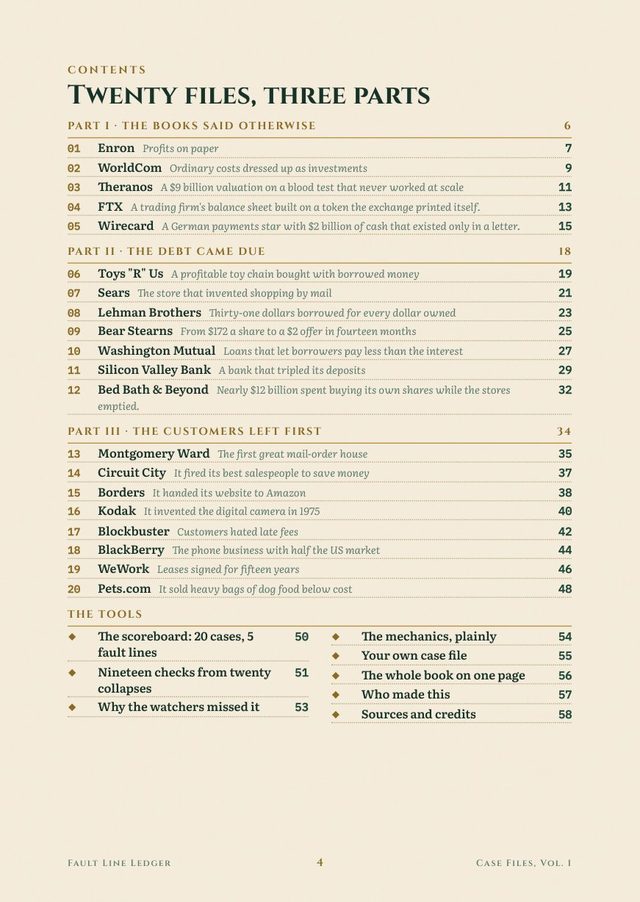
  1. 01Enron
  2. 02WorldCom
  3. 03Theranos
  4. 04FTX
  5. 05Wirecard
Part II · 7 cases

The debt came due

Borrowed money, short funding or a buyout set the clock running.

  1. 06Toys "R" Us
  2. 07Sears
  3. 08Lehman Brothers
  4. 09Bear Stearns
  5. 10Washington Mutual
  6. 11Silicon Valley Bank
  7. 12Bed Bath & Beyond
Part III · 8 cases

The customers left first

The market moved and the company stayed put, or cut the wrong thing.

  1. 13Montgomery Ward
  2. 14Circuit City
  3. 15Borders
  4. 16Kodak
  5. 17Blockbuster
  6. 18BlackBerry
  7. 19WeWork
  8. 20Pets.com
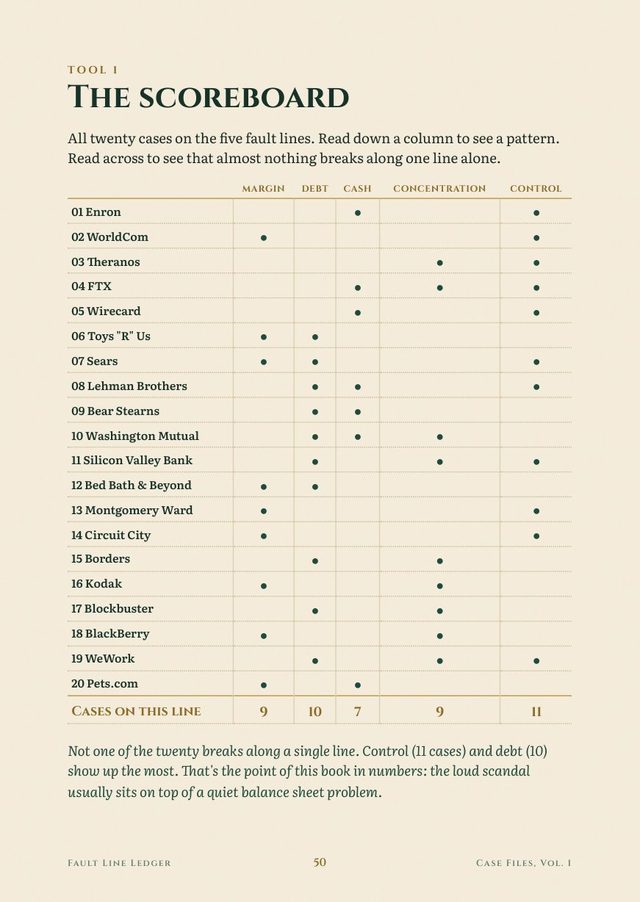
The scoreboardAll 20 cases on the five fault lines: margin, debt, cash, concentration and control.
Nineteen checksEvery "Check it today" in one tick-box table, each tied to the case it came from.
Why the watchers missed itWhat the record shows about the auditors, boards and regulators in eight cases.
The mechanics, plainly18 terms, from mark-to-market to reverse splits, in one line each.
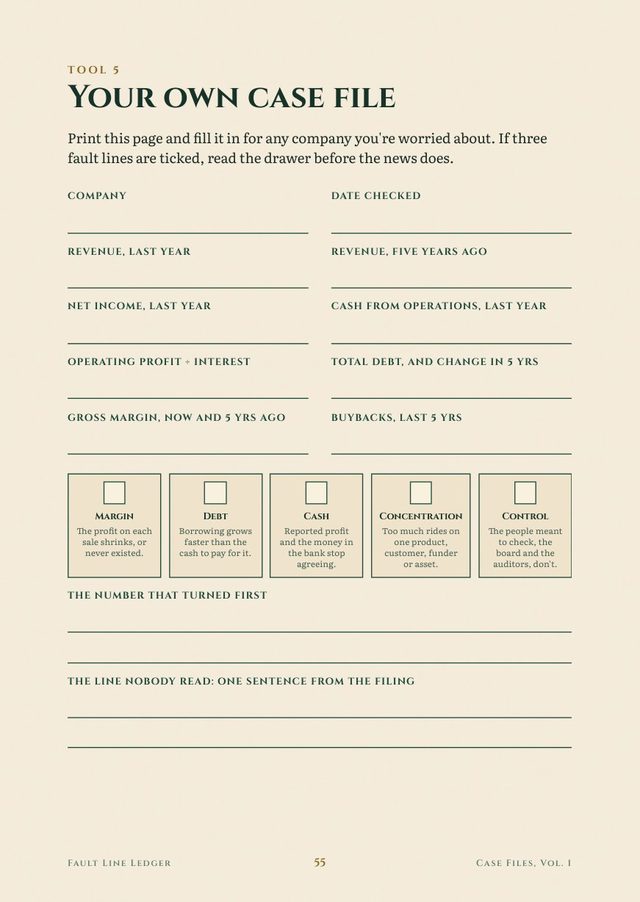
Your own case fileA printable page to run the five fault lines on any company.
The whole book on one pageThe idea, the fault lines and the five checks to run first.
$17Buy the 58-page book

Instant PDF download. Secure Stripe checkout. All sales are final.

Real pages from the book

Look before you buy

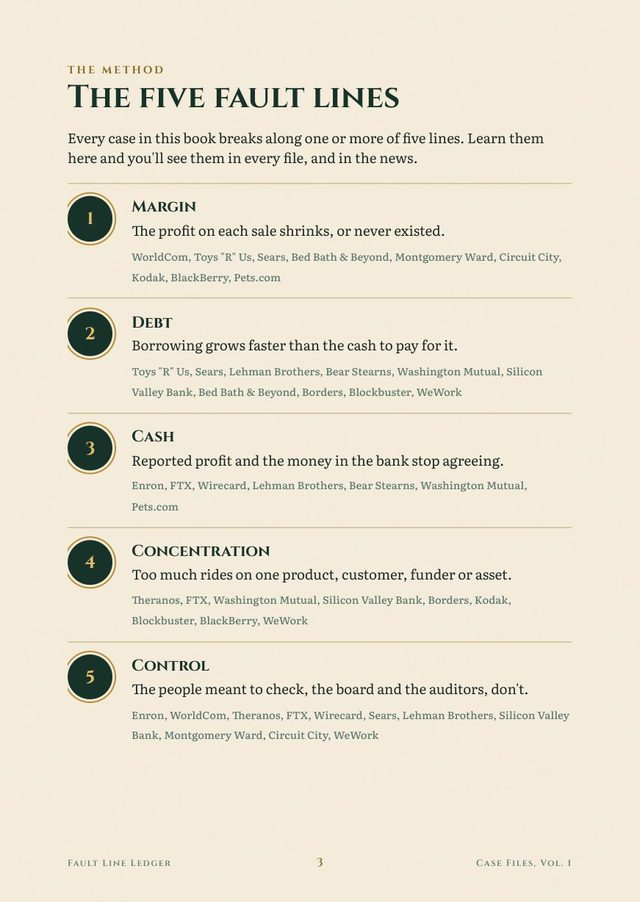
Page 3: the five fault lines
The five fault lines, the method behind every case
Page 4: contents
The contents: twenty files in three parts
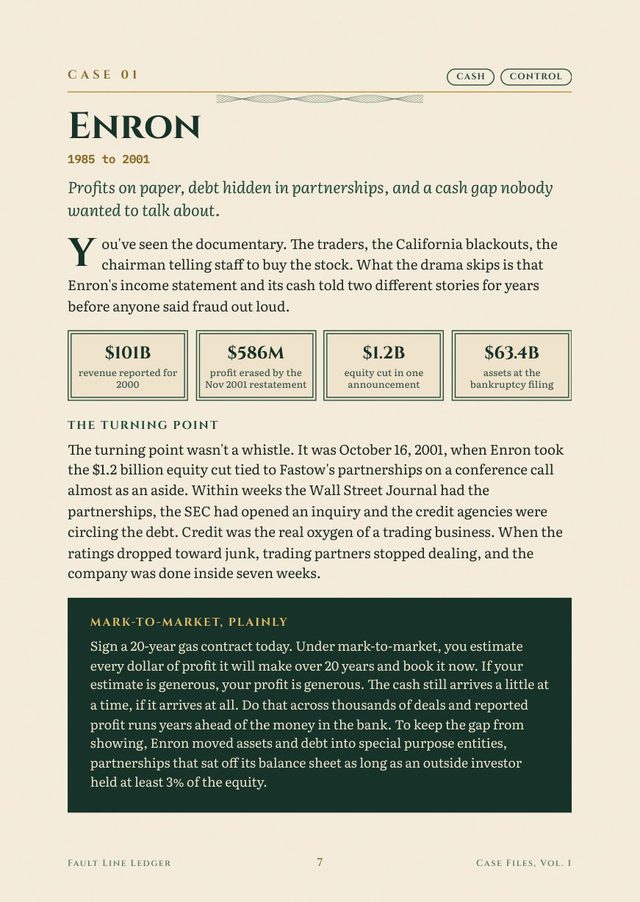
Page 7: the opening of the Enron case
Case 01 opens: Enron's four numbers
Page 29: Silicon Valley Bank case
Silicon Valley Bank, from the free lesson above
Page 50: the scoreboard
The scoreboard: 20 cases, 5 fault lines
Page 55: your own case file
Your own case file, ready to print

Who made this

Walt Brennan

Walt Brennan, Fault Line Ledger

I host Fault Line Ledger, where I read company filings out loud and explain where it really went wrong. I believe the cause is in the filings before it's in the news, and that anyone who can read a bank statement can read a balance sheet if someone explains it plainly.

20companies, from 1872 to 2023
54primary sources: filings, examiner reports, court records
122dated timeline entries
80key numbers, case by case

What this book won't do

Volume 1, first edition. Facts checked November 6, 2026.

Questions

Before you buy

I've watched the documentaries. Is this the same stories again?

No. The documentaries tell the drama. Each file here is the cause: the dated timeline, four key numbers, the turning point, the mechanic behind it and the sources, so you can check every claim yourself.

Do I need to know finance?

No. Every term is explained the first time with an everyday example, like a phone bill or renting back your own house, and all 18 are collected in one glossary at the back.

Will it tell me which stocks are next?

No, and that's on purpose. It gives you nineteen checks that turned up before real collapses, so you can run them yourself on any company you own or work for.

How do I get it, and does it work on a phone?

You download a 58-page PDF right after paying. It's laid out at a book page size that reads well on phones, tablets and laptops, and prints cleanly.

Can I get a refund?

All sales are final. This is a digital download you get right away, so we don't offer refunds. This doesn't affect any rights you have by law. The free lesson, the contents and six real pages are on this page so you can check before buying.

Not ready yet?

Take the free Old Price Fixer, a one-page sheet for adjusting any old share price after reverse splits and bankruptcies.

You'll also get emails from Fault Line Ledger. Unsubscribe any time.

Read the drawer, not the lobby

Twenty collapses, the numbers that turned first, and the checks to spot them yourself.

$17Buy the 58-page book

Instant PDF download. Secure Stripe checkout. All sales are final.